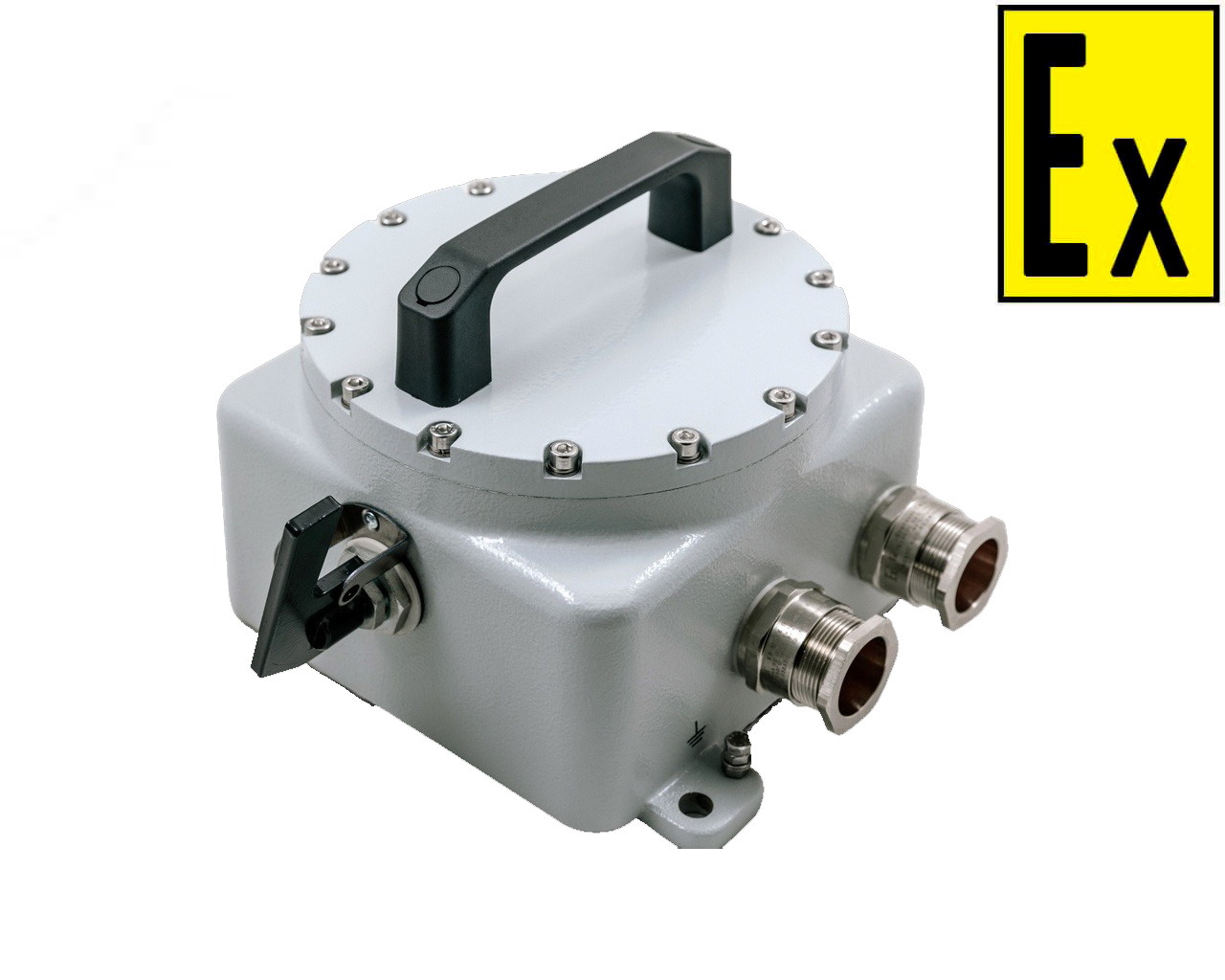


An explosion-proof switch is a switching device enclosed in a special protective shell, designed to protect electrical networks from short circuits and overloads , as well as to quickly turn on and off equipment in hazardous areas .
Such devices are used in oil and gas, chemical, mining and coal industries where explosive gases, vapors or dust may be present in the air.
The device's primary purpose is to isolate sparks and high temperatures generated when contacts open from the external explosive environment. The switch is a ready-made solution, housed in an explosion-proof enclosure with cable entries and a remote control handle. Depending on the order, the switch is equipped with:
Explosion-proof enclosure (protection type "d"): Internal components (contacts, thermal and electromagnetic tripping devices) are housed in a highly durable aluminum alloy housing. The housing withstands the pressure of an internal explosion and prevents flames from escaping.
The switches comply with the following standards: TR CU 004/2011, TR EAEU 037/2016, GOST IEC 60898-1, GOST IEC 60947-2.
| Nominal working voltage: | 230/400 V |
| Nominal frequency of AC network: | 50/60 Hz |
| Rated impulse withstand voltage: | 4 kV |
| Nominal insulation voltage: | 500 V |
| Load connection: | from above or below |
| Maximum cross-section of the connected wire | 16 mm2 |
| Other characteristics: |
Switch-A:
| Number of poles: | 2, 4 |
| Range of rated currents (optional): | 6, 10, 16, 25, 32, 40, 50, 63 A |
| Rated and working breaking capacity: | 6 kA |
| Disconnection curve: | WITH |
| Mechanical wear resistance, cycles B-O, not less than: | 25,000 |
| Switching wear resistance, B-O cycles, not less than: | 6000 |
Switch-D:
| Number of poles: | 1+N, 3+N |
| Range of rated currents (optional): | 6, 10, 16, 25, 32, 40, 50, 63 A |
| Nominal working voltage: | 230/400 V |
| Nominal frequency of AC network: | 50/60 Hz |
| Rated and working breaking capacity: | 6 kA |
| Disconnection curve: | WITH |
| Rated residual current: | 30 mA |
| Response time: | <0.1 s |
| Type of differential tripping device | AS |
| Mechanical wear resistance, cycles B-O, not less than: | 20,000 |
| Switching wear resistance, cycles B-O, not less than: | 10000 |
Switch-N:
| Number of poles: | 2, 4 |
| Range of rated currents (optional): | 20, 32, 63 A |
| Nominal working voltage: | 230/400 V |
| Nominal frequency of AC network: | 50/60 Hz |
| Application category: | AC-22 |
| Rated short-circuit making capacity: | 28.1xIn |
| Rated short-time withstand current (up to 1 s): | 20xIn |
| Mechanical wear resistance, cycles B-O, not less than: | 50,000 |
| Switching wear resistance, B-O cycles, not less than: | 32A: 30,000 6ZA: 20,000 |
Case material: aluminum alloy with a total content of magnesium, titanium, zirconium of no more than 7.5%.
Cables are connected to the posts using screw terminals on the switch installed inside the enclosure, according to the diagram (Appendix G). The ground wire is connected via a separate terminal clamp. The terminal clamps used are KRUSLG-16N (DKC).
The posts are equipped with two explosion-proof cable entries of the KV series, TU 27.33.13-359-81888935-2019. The connecting thread of the cable entries is M25x1.5. The cable entries allow the input and output of round cables of various diameters:
The service life of the posts before decommissioning is 10 years.